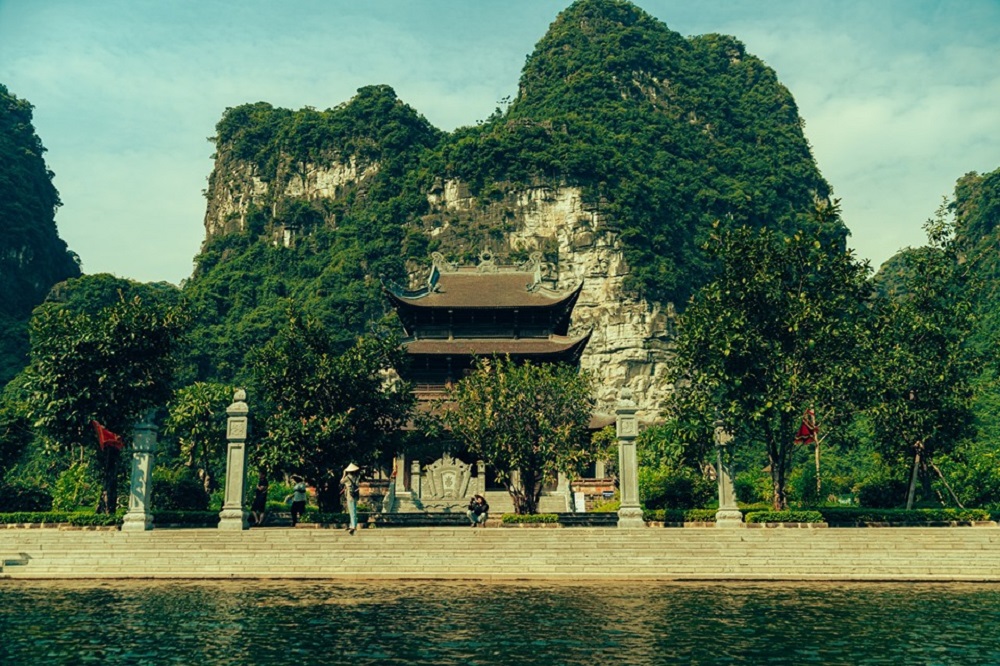
According to the Management Board of the Trang An Scenic Landscape Complex, the langur troop is in good health, fully adapted to the natural environment, and continues to maintain its reproductive capacity.

In August 2020, three white-butt langurs, one male and two females were transferred from the Endangered Primate Rescue Center (Cuc Phuong National Park) to Trang An. This area was once a traditional habitat for the species but had seen their disappearance for many years due to habitat degradation.
During the initial phase, the animals were kept under semi-wild care to acclimate to the climate, diet, and limestone terrain. Staff members who are professionally trained by Cuc Phuong experts, monitored them continuously to assess their adaptation.
By October 2020, all three langurs were fully released into the natural environment on Ngoc Island. A little more than a year later came the first joyful milestone: a baby langur was born on October 24, 2021, weighing nearly 300 grams. This birth marked a significant indicator confirming that Trang An provides suitable conditions for rebuilding a new white-butt langur population.
Ngoc Island is a completely isolated area with no agriculture, quarrying, or human activities. This ecological setting forms a “natural shield,” protecting the langurs from hunting, pollution, and disturbance.
Here, regular monitoring is carried out, and when necessary, specialized teams can provide veterinary support or swift rescue interventions. However, natural factors such as climate fluctuations, seasonal food availability, or disease remain long-term challenges for conservation.
The white-butt langur (Trachypithecus delacouri) is currently one of the most endangered primate species on Earth, with a global population of just over 300 individuals. Van Long Wetland (Gia Vien, Ninh Binh) is home to the largest langur community in the world, accounting for more than 70% of the global population. Another population of around 60 individuals has been recorded in Kim Bang (Ha Nam).
The successful establishment and maintenance of a new langur troop in Trang An not only makes a crucial contribution to the species’ gene pool but also demonstrates Ninh Binh’s strong commitment to biodiversity conservation — the foundational value of the Trang An World Heritage.
The increasingly stable presence of the white-butt langur troop on Ngoc Island stands as a vivid testament to nature’s resilience when it is given the respect, understanding, and protection it deserves.